
Poker analyzer systems are most commonly associated with Texas Hold’em and Omaha, but their underlying technology—barcode scanning, real-time card identification, and computational game logic—adapts to any card game where advance knowledge of cards creates strategic advantage. Blackjack and baccarat are two such games, and modern poker analyzer devices include dedicated game modes with features tailored to each. This article examines how analyzer systems work for blackjack and baccarat, what game-specific calculations they perform, and how users configure these modes for real-world sessions.
Why Poker Analyzers Extend Beyond Poker
The core capability of any poker analyzer system is identifying barcode marked cards before they are revealed to all players. This function—knowing which card is about to be dealt—is valuable in any card game where information asymmetry creates advantage. In poker, knowing hole cards informs betting. In blackjack, knowing the next card transforms basic strategy into near-perfect play. In baccarat, knowing upcoming cards enables road map prediction that overshadows statistical trend analysis.
The hardware remains the same: a poker scanning camera reads barcode marked cards, the analyzer host unit decodes and runs game logic, and a hidden earpiece delivers results. What changes between game modes is the software—the algorithms executed after card identification.

Blackjack Mode: Card Counting and Next-Card Knowledge
Blackjack is a game where remaining deck composition directly affects expected return. Traditional card counting systems (Hi-Lo, KO, Omega II) track the ratio of high to low cards. A poker analyzer in blackjack mode goes far beyond traditional counting by providing exact knowledge of specific upcoming cards.
How Blackjack Mode Processes Card Data
When the analyzer identifies a card via barcode scanning, the blackjack game logic module performs two parallel operations:
Running count update: The system tracks all dealt cards with perfect accuracy, maintaining an internal count that never misses cards or loses accuracy during fast dealing. It supports Hi-Lo (default on most units), KO, and custom counting systems configurable through settings.
Next-card identification: When the scanner reads a card about to be dealt, the system communicates that specific card before the dealer reveals it. Knowing the exact next card eliminates probability-based decision-making and replaces it with deterministic optimal play.
Blackjack Decision Logic with Known Cards
With next-card knowledge, the analyzer computes optimal actions with certainty:
– Hit or stand: If the player holds 12 and the next card is 5, hitting produces 17—the system recommends hit. If the next card is 10, hitting busts at 22—the system recommends standing.
– Double down: A hard 9 against dealer’s 6 is borderline in basic strategy; knowing the next card is 10 makes it a guaranteed strong double (producing 19).
– Insurance: If the system identifies the dealer’s hole card, insurance becomes straightforward—take it if the hole card produces a dealer blackjack.
– Split decisions: Known upcoming cards inform whether splitting produces two strong or two weak hands.
The analyzer communicates recommendations via earpiece using voice announcements (“Hit,” “Stand,” “Double,” “Split”), numeric codes (1=Hit, 2=Stand, 3=Double, 4=Split), or custom tone patterns.
Multi-Shoe Tracking and Penetration
Advanced blackjack mode (CVK 700, AKK A5) supports multi-shoe tracking for 6-deck or 8-deck shoes. The analyzer tracks all dealt cards, maintaining accurate running and true counts. Users set the expected penetration depth (typically 65–75% for 6-deck shoes), and the system alerts via earpiece when penetration reaches the threshold, signaling imminent reshuffle.
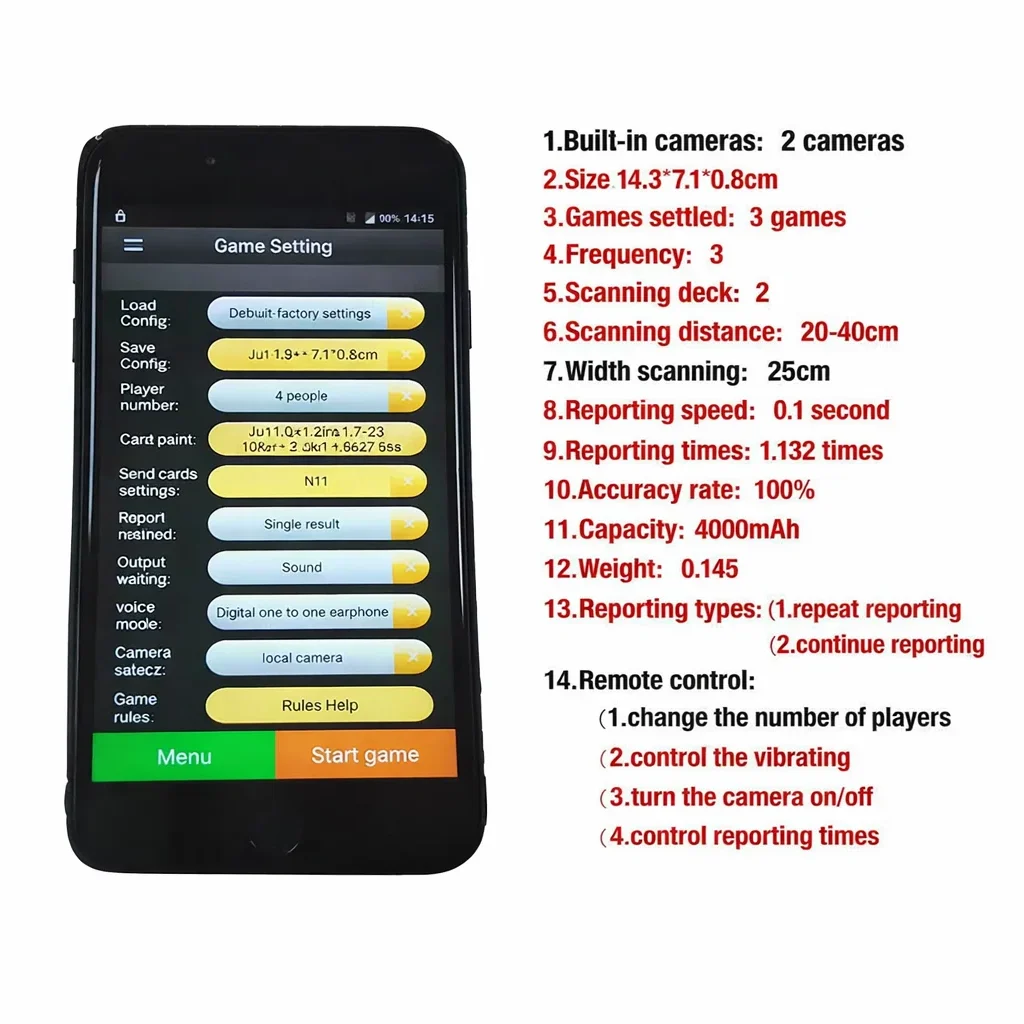
Blackjack Mode Configuration
– Game code: Codes 6–8 for single-deck, 6-deck, and 8-deck variants with different rule assumptions (dealer stands/hits soft 17, surrender availability)
– Number of decks: 1, 2, 6, or 8—set in game parameters
– Counting system: Hi-Lo (default), KO, or custom point values
– Penetration threshold: Percentage of shoe depletion for reshuffle alert
– Output format: Voice, code, or tone patterns
Baccarat Mode: Road Map Prediction and Card Sequence Analysis
Baccarat compares two hands—Player and Banker—with each coup resulting in Player win, Banker win, or Tie. The game’s fixed dealing rules make it particularly amenable to analyzer prediction: knowing remaining cards allows the system to predict future coup outcomes with high accuracy.
Baccarat Dealing Rules and Deterministic Simulation
Baccarat follows strict automatic rules for third-card draws. If either hand totals 8 or 9 (natural), no third card is drawn. Player draws on 0–5 and stands on 6–7. Banker draws based on Player’s third card and Banker’s total. Because these rules are deterministic, an analyzer knowing upcoming card sequences can simulate each coup’s exact outcome before it occurs—no probabilistic branching required.
Road Map Prediction
Baccarat players track coup outcomes using road maps—Big Road, Bead Road, Big Eye Road, Small Road, and Cockroach Road. The analyzer doesn’t merely display past results; it predicts future road map entries by simulating upcoming coups from known card sequences. This provides advance knowledge of the next 3–5 coup outcomes, allowing bets with near-certainty rather than pattern-based guessing.
The earpiece delivers predictions as: “P” or “B” for Player/Banker wins, “T” for Tie, or sequential predictions like “B-P-B-B” indicating the next four coup outcomes.
Each coup simulation takes approximately 10–15 milliseconds on the analyzer’s ARM processor (Cortex-A53 at 1.0–1.2 GHz)—far lighter than poker probability calculations because baccarat rules require no probabilistic branching.
Baccarat Mode Configuration
– Game code: Codes 9–10 for standard baccarat and mini/no-commission variants
– Commission setting: Whether the system accounts for 5% Banker commission in outcome valuation
– Prediction depth: 1–5 future coups; greater depth requires more advance card scanning
– Output format: Full voice, abbreviated codes, or custom tone patterns
Multi-Game Support and Game Code Selection
Modern analyzers support multiple game modes selectable through the device menu. The game code system tells the analyzer which logic module to activate:
| Game Code | Game Mode | Supported On |
|—|—|—|
| 1 | Texas Hold’em (2 players) | CVK 600, CVK 700, AKK A3, AKK A5 |
| 2 | Texas Hold’em (3–6 players) | CVK 600, CVK 700, AKK A3, AKK A5 |
| 6 | Blackjack (single deck) | CVK 600, CVK 700, AKK A3, AKK A5 |
| 7 | Blackjack (6-deck shoe) | CVK 700, AKK A5 |
| 8 | Blackjack (8-deck shoe) | CVK 700, AKK A5 |
| 9 | Baccarat (standard) | CVK 700, AKK A5 |
| 10 | Baccarat (mini/no commission) | CVK 700, AKK A5 |
Older models (CVK 600, AKK A3) handle basic blackjack and poker but lack processing power for advanced baccarat simulation. The CVK 700 and AKK A5, with faster processors, support the full game code range.
Switching game modes takes 2–5 seconds via touchscreen or wireless remote. Best practice: select the correct mode before entering the game environment to avoid mid-session handling that may attract attention PokerAnalyzerShop.
Analyzer Effectiveness by Game Type
| Game Type | Information Value | Advantage Type | Scanning Ease | System Complexity |
|—|—|—|—|—|
| Blackjack | Very high (exact next card) | Deterministic edge | Moderate (systematic shoe dealing) | Moderate |
| Baccarat | High (predicted coup outcomes) | Deterministic prediction | Moderate (fixed dealing sequence) | Low |
| Texas Hold’em | High (opponent hole cards) | Probabilistic edge | Variable | High |
| Omaha | Very high (4 hole cards) | Strong probabilistic edge | Variable | Very High |
Blackjack and baccarat offer deterministic advantages—knowing the next card or coup outcome produces mathematically certain optimal decisions, not probabilistic improvements.
Practical Setup Tips
Blackjack: Position the scanner to read cards exiting the shoe—table dispenser or phone case scanners near the dealer’s end work best. For single-deck hand-held games, watch or phone case scanners near the player position read pitched cards. Periodically verify the analyzer’s running count against your mental count to catch missed scans.
Baccarat: Baccarat tables are larger, requiring scanner range of 25–50 cm minimum. CVK 700 and AKK A5 modules with longer ranges are better suited. Practice scanning speed with marked cards before actual games. Predictions must arrive before betting closes (10–20 second window between coups).
Honest Limitations
– Standard rules assumption: Blackjack mode assumes specific rule variants. Non-standard rules (dealer hits soft 17, 6:5 blackjack payoffs) produce suboptimal recommendations unless the correct game code is selected.
– Missed card impact in baccarat: A single missed scan invalidates all subsequent predictions that depend on that card’s position in the sequence.
– Continuous shuffling machines (CSMs): CSMs reinsert dealt cards continuously, making all tracking and prediction impossible. This is a fundamental limitation of any card tracking technology.
– Mini-baccarat speed: 150+ coups per hour demands fast bet placement based on earpiece signals. The system processes fast enough, but the user must act quickly.
– Shoe penetration limits in blackjack: Advantage varies with penetration depth. Early-shoe advantage is moderate; late-shoe with favorable count is larger but resets at reshuffle.
FAQ
Q: Does the same analyzer hardware work for blackjack and baccarat?
A: Yes. The scanning camera, analyzer host, and earpiece are identical regardless of game type. The game code selection changes only the software logic module. A CVK 700 or AKK A5 can switch between blackjack and baccarat modes through the menu system using the same hardware.
Q: How does the analyzer handle multi-deck blackjack shoes?
A: The system tracks all dealt cards across the entire shoe, maintaining accurate running and true counts. It supports 1-deck, 6-deck, and 8-deck configurations through different game codes and alerts when penetration reaches a configurable reshuffle threshold.
Q: Can baccarat mode predict Tie outcomes?
A: Yes, the simulation engine computes all outcomes including Tie. However, Tie bets carry a high house edge (~14.4%) despite occurring ~9.5% of the time, so most users focus on Player and Banker predictions for their lower house edge (~1.06% and ~1.24% respectively).
Q: What if the casino uses a continuous shuffling machine?
A: CSMs continuously reinsert dealt cards, making card tracking impossible. The analyzer cannot provide meaningful advantage with a CSM in use—this applies to both blackjack and baccarat. This is a fundamental limitation of any card tracking technology, not specific to any analyzer model.
Q: How many future baccarat coups can the analyzer predict?
A: The prediction depth setting is configurable from 1–5 coups. Greater depth requires more advance card scanning, which may not be feasible during fast dealing. In practice, 1–3 coup predictions are most commonly used.